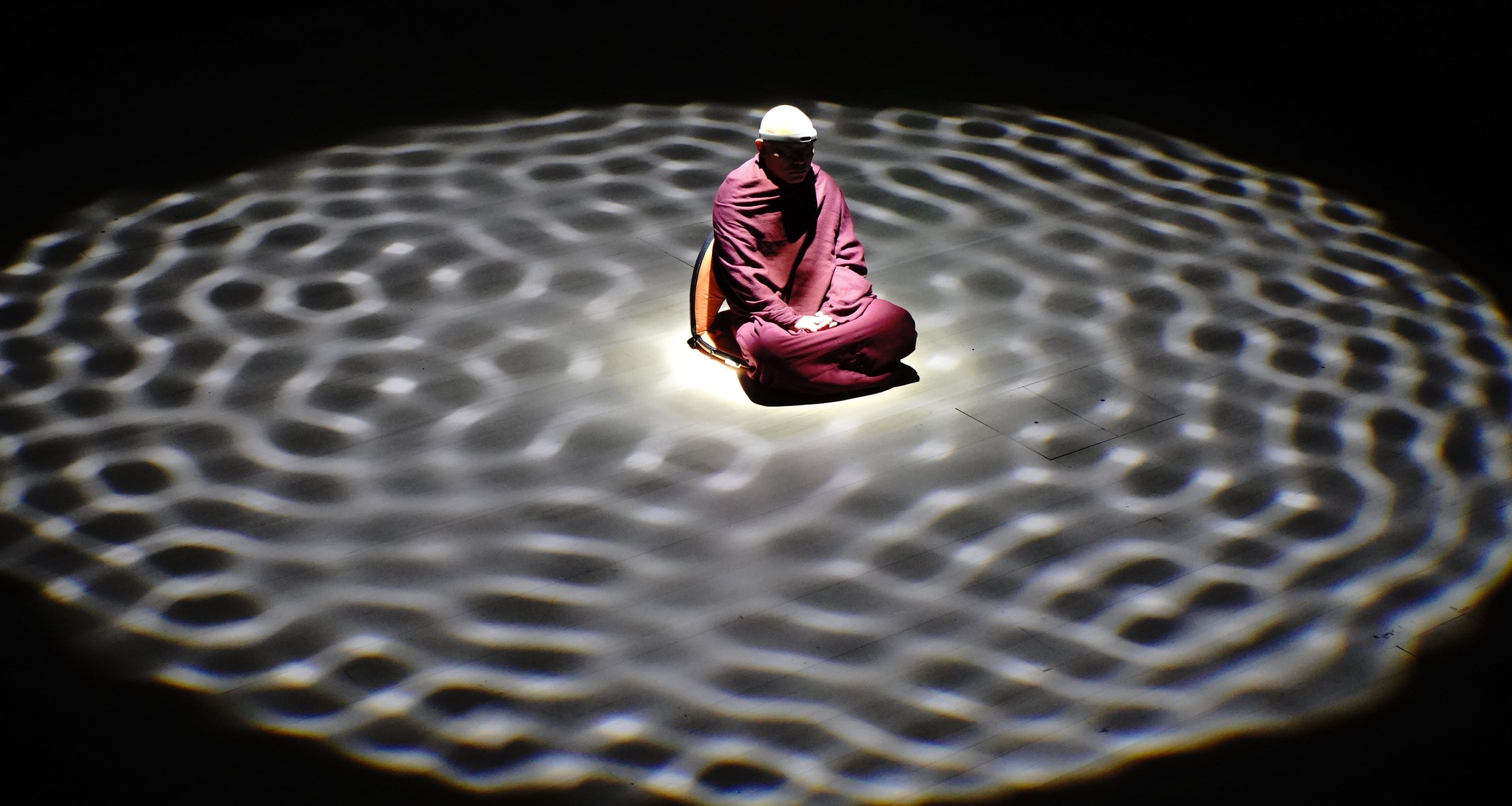
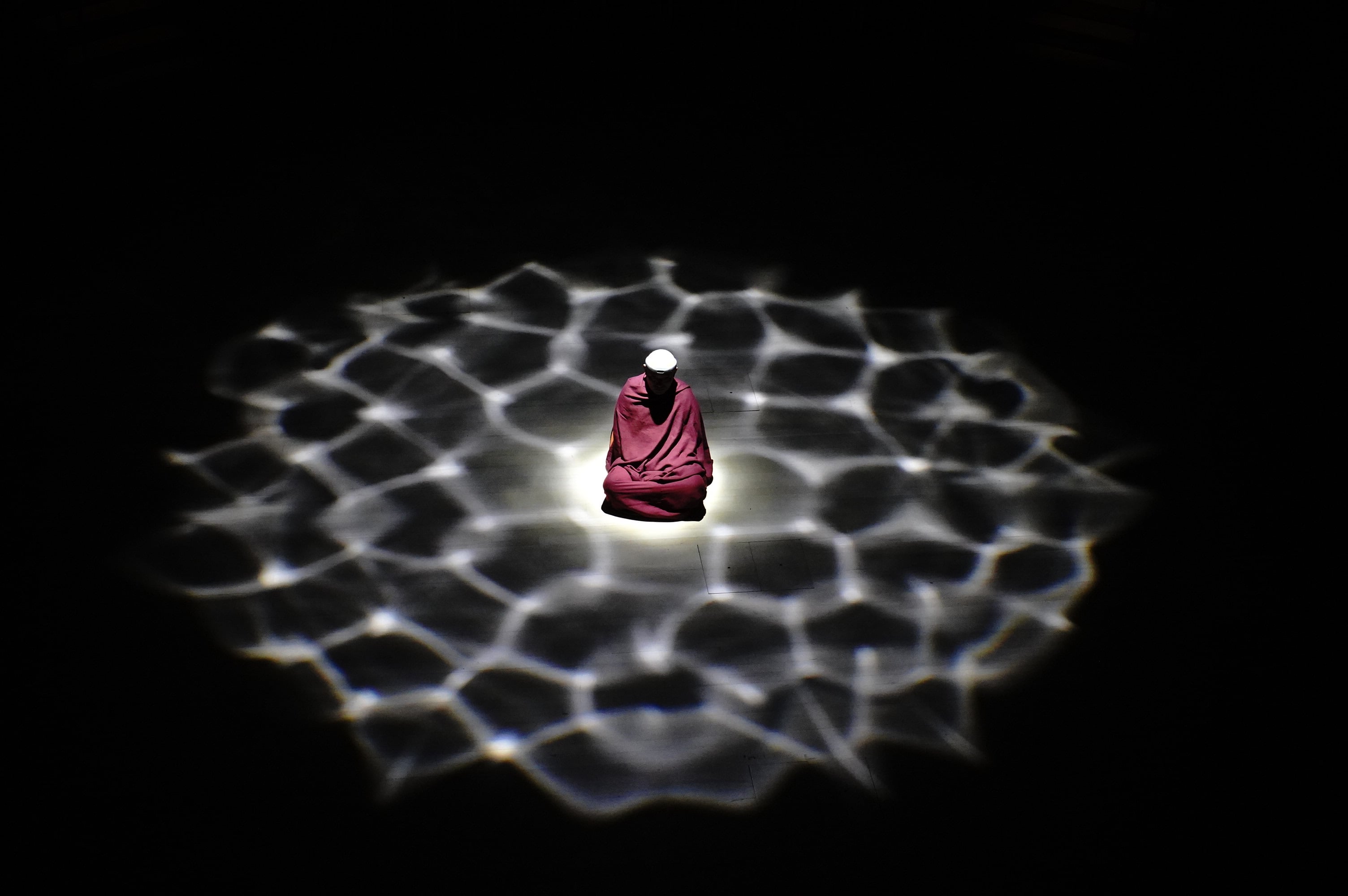
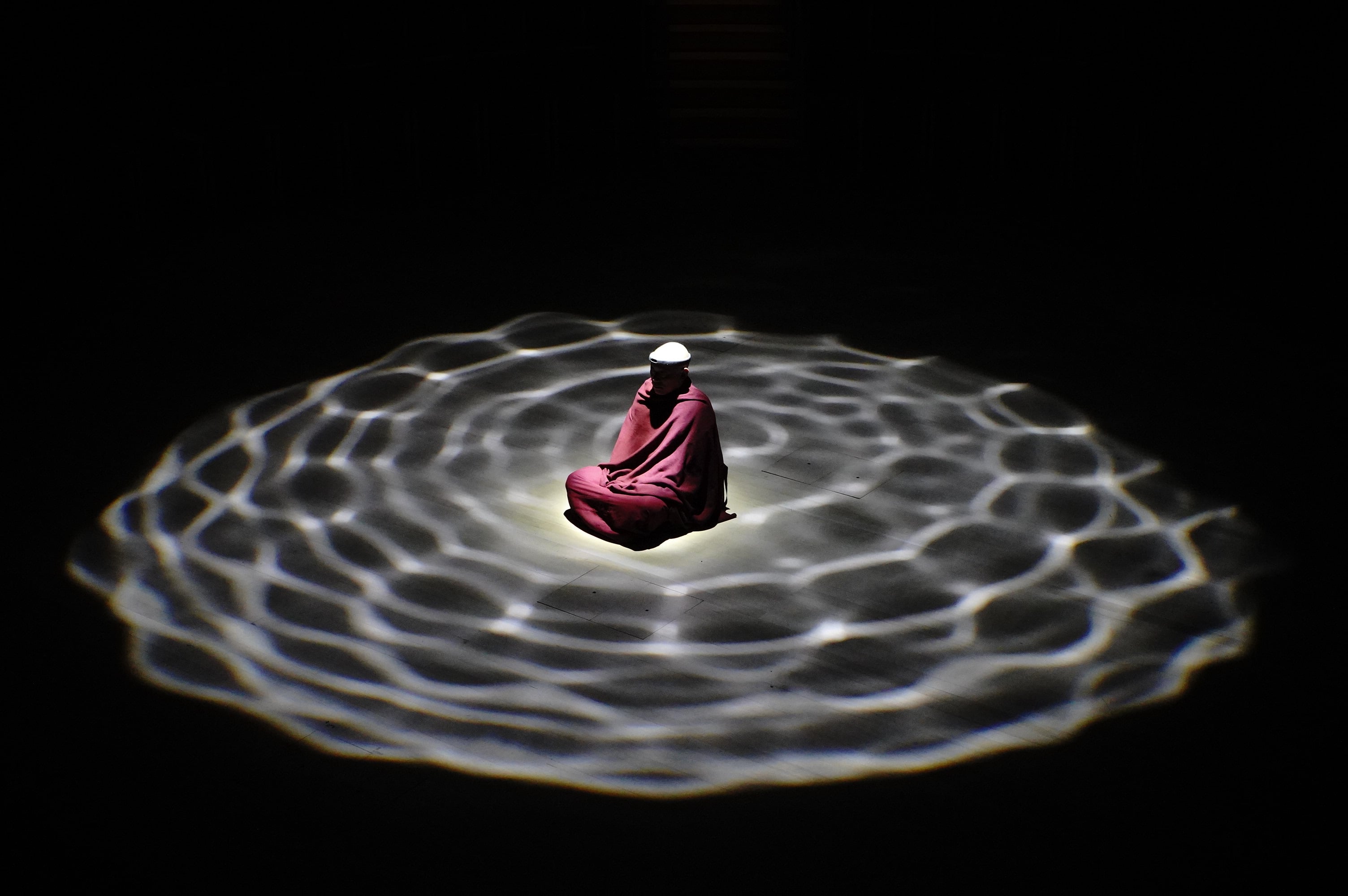
Resonance explores the relationship between mind and matter through an immersive contemplative installation. The work translates the brainwaves of a meditating Buddhist monk into dynamic water patterns, casting shifting reflections of light throughout the space. As neural rhythms animate the liquid surface, thought becomes movement, rendering invisible states of attention and awareness perceptible through light and vibration. In doing so, the installation transforms a traditionally solitary contemplative practice into a shared spatial experience. Drawing upon ancient mindfulness traditions while engaging contemporary brain–computer interface technologies, Resonance proposes an alternative trajectory for neural systems, one that fosters collective presence rather than extraction or optimization. Cognition is reframed not as private computation, but as atmosphere: something that can be sensed, inhabited, and reflected upon together. Grounded in contemplative practice, neuroscience, and design, the project also addresses accessibility. While meditation often requires sustained training, Resonance lowers the threshold for engagement by externalizing internal rhythms through sensory feedback, inviting participants into embodied awareness without prior discipline. Presented within MIT’s newly completed music hall designed by SANAA, the installation occupied the building’s vertical expanse, suspended from a forty-foot-high ceiling. The architectural volume, acoustics, and reflective surfaces became active components of the work, transforming the hall itself into a responsive field of light, water, and shared resonance.
In this initial prototype, neural activity was translated into physical motion through an interactive system in which a subwoofer vibrated a shallow body of water, allowing patterns of attention and focus to emerge as visible ripples on the surface. Through iterative experimentation, we established the optimal mapping strategy connecting the EEG-derived meditation index to the vibration parameters that govern the emergent wave patterns. These insights laid the groundwork for the current installation.
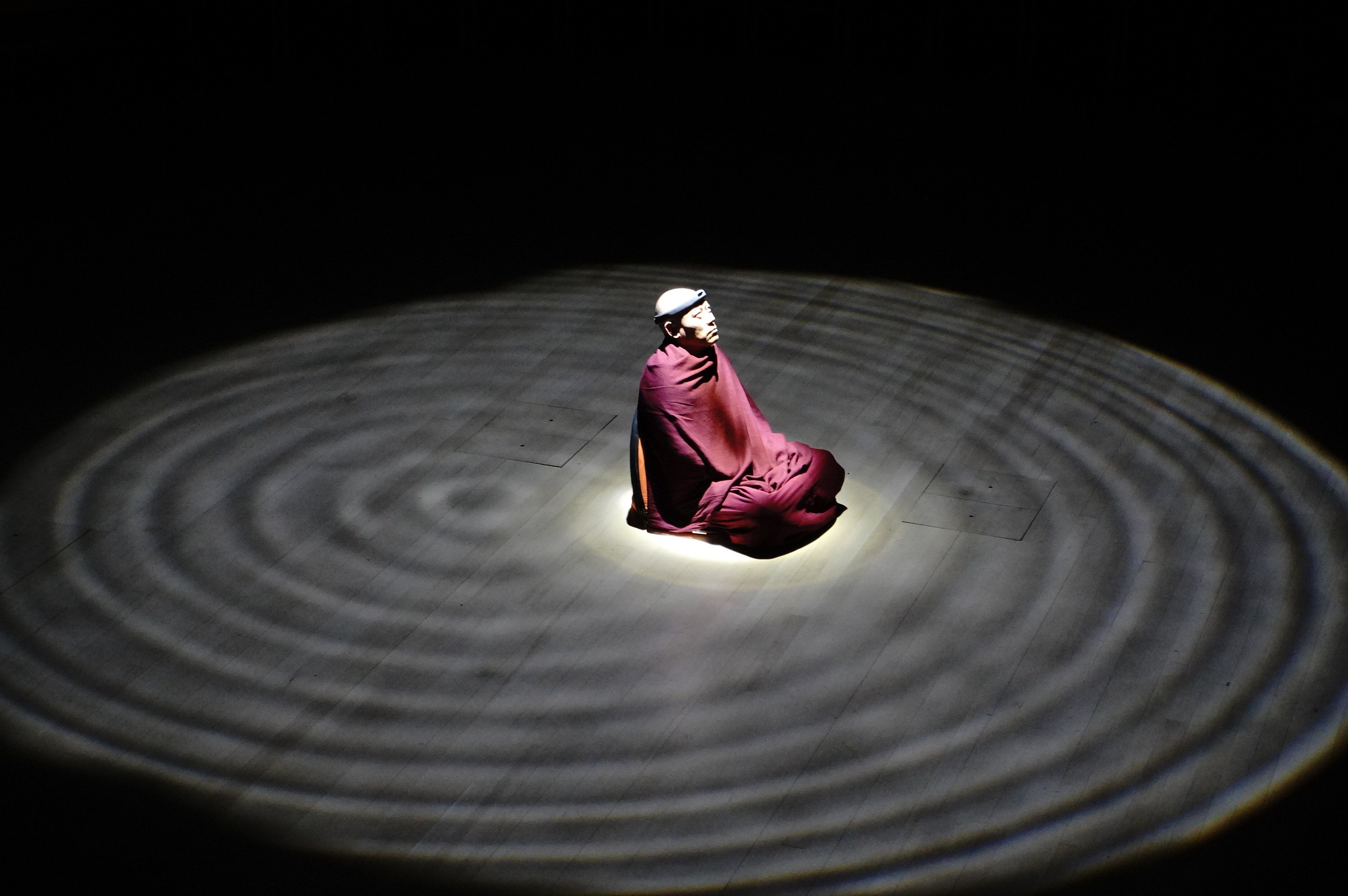
Developed for The Thomas Tull Concert Hall at The Edward and Joyce Linde Music Building (W18), Resonance scales earlier technical findings into an architectural intervention. By suspending a transparent vessel via a mechanical hoist, the work engages the hall’s verticality, transforming the liquid into a dynamic lens that translates neural fluctuations into a grand spatial performance. Unlike traditional cymatics that place the audience at a fixed vantage point, Resonance situates viewers within the projected field itself. By casting light downward through the suspended structure, the installation leverages the hall’s geometry to create an immersive environment of shifting caustics. Here, the architecture is no longer a backdrop but an active participant, externalizing the meditator’s internal state into a shared, collective experience.
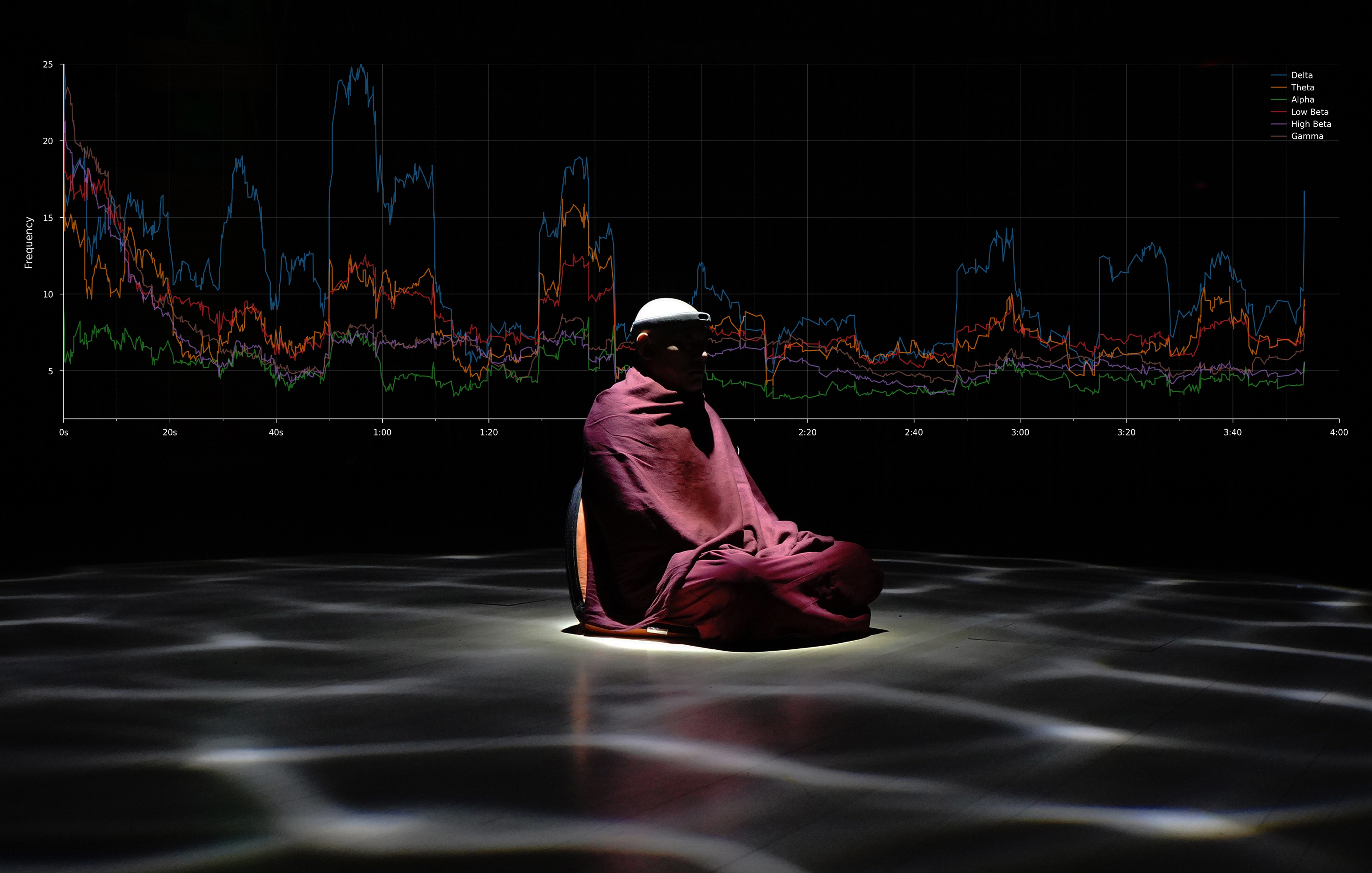
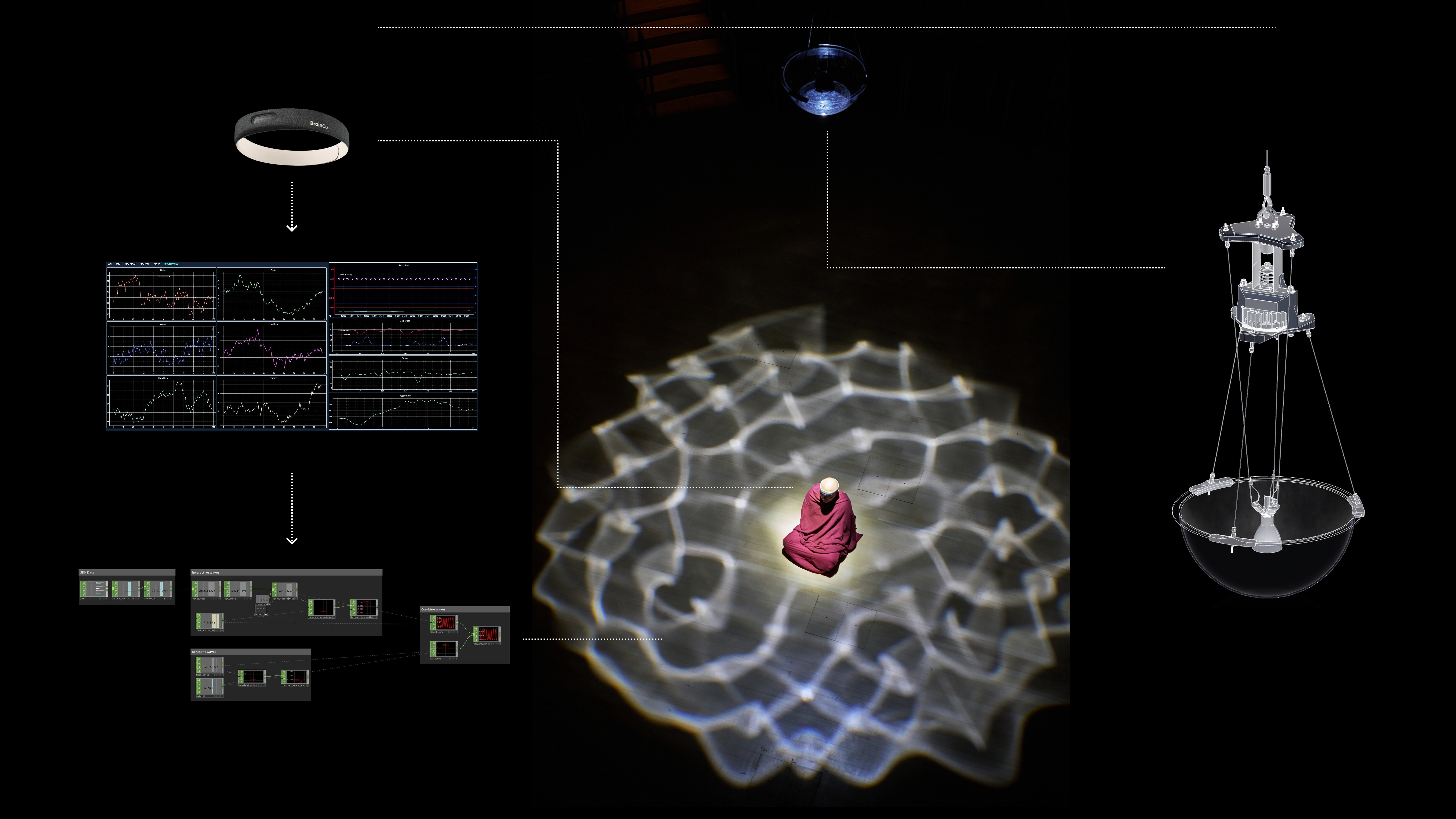
Mechanical design of the installation. Components include a 24-inch acrylic hemisphere and custom mounting parts fabricated in-house using FDM 3D-printed polycarbonate and laser-cut 6061 aluminum sheets. Metal hardware, cables, and connectors were sourced from commercially available products and McMaster-Carr, selected and rated based on load calculations and performance requirements. Spectral analysis of the monk’s EEG data recorded during a 4-minute meditation session. The graphic visualization plots the evolution of distinct frequency bands (Delta, Theta, Alpha, Beta, Gamma) over time. The vertical axis represents the relative spectral power (activity level) of each band, while the horizontal axis indicates the duration of time. Note the prominent rhythmic fluctuations in the Alpha and Theta bands, which the system isolates to compute the “Meditation Index.”
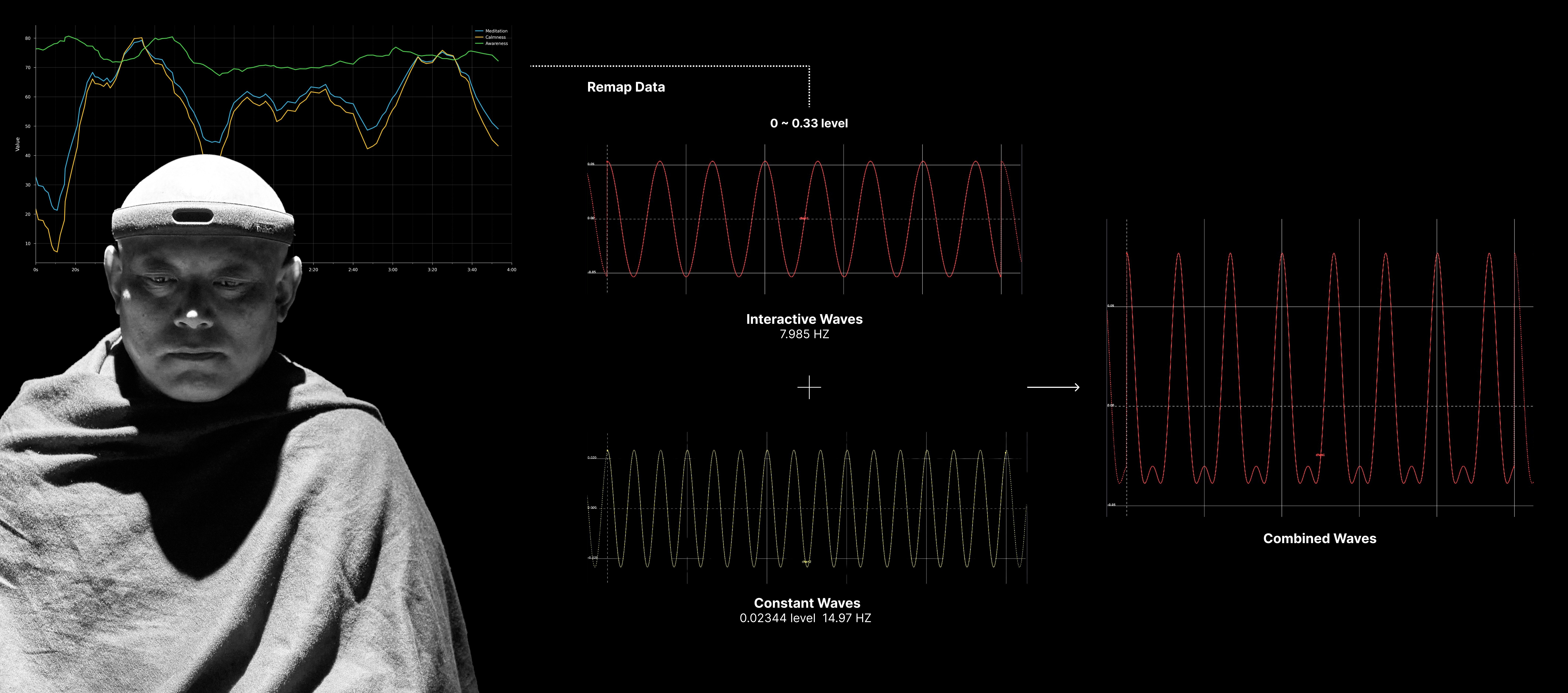
The system processes real-time meditation data from the BrainCo SDK in TouchDesigner, driving an actuator by summing a stable "Constant Wave" (14.971 Hz) and a neural-modulated "Interactive Wave" (7.485 Hz). The 2:1 harmonic ratio ensures phase coherence, allowing the waves to reinforce each other into stable Faraday patterns. As the meditation index rises, the combined amplitude increases, shifting the water surface from subtle ripples to sharp, high-relief geometric ridges.
Three visual states corresponding to meditation index amplitude. Pattern~1 (0--0.11): simple, broad waves in a steady rhythm, reflecting a relaxed state. Pattern~2 (0.11--0.22): broad waves mixing with detailed ripples. Pattern~3 (0.22--0.33): small, dense waves forming a complex, textured field, corresponding to deeper meditative focus. The work was realized through live performances featuring a Buddhist monk with extensive contemplative practice and a sound bowl artist generating resonant frequencies during meditation. Audience responses consistently described a shared sense of presence and peace, with viewers noting heightened awareness of their own bodily states alongside feelings of connection to others in the space.
- Behnaz Farahi
- Ruipeng Wang
- Yuxiang Cheng
- Annie Xing
- Hannah Lim
- Julian Ceipek
- Paolo Salvagione
- Jimmy Day
- Geshe Tenley
- Abigail Frechette
Credit
- Collaboration
- John Werner
- Clayton D. Hainsworth
- Cornelle King
- Candido Monteiro
- MIT Music Hall